← All units
Unit 02Foundations6 min

Position Is Power

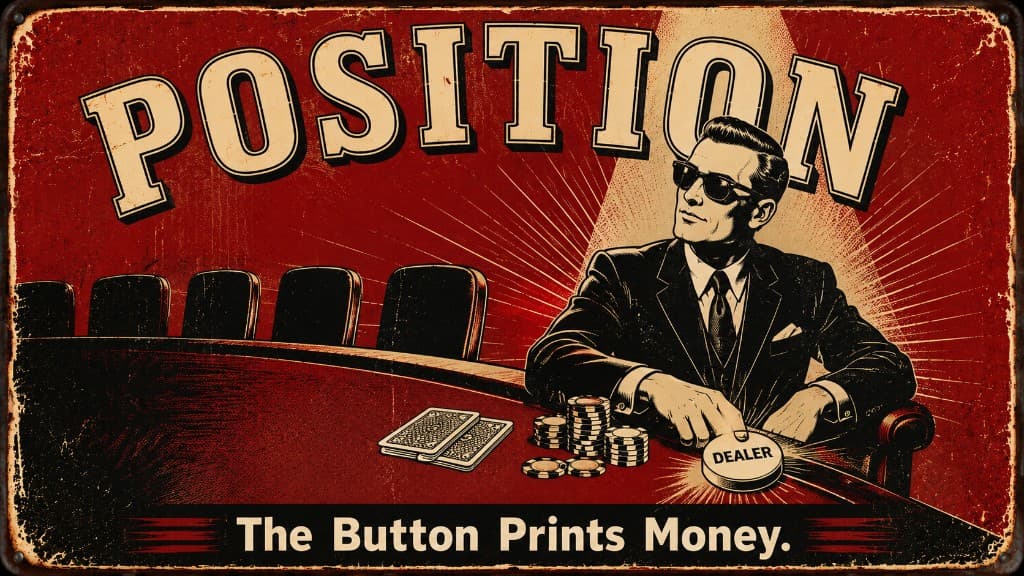
The button prints money. Here's the mechanical reason why.

Vintage pulp poster: POSITION — The Button Prints Money.
The idea

Acting last means you see everyone's decision before you make yours. More information, same cards — that edge compounds every single street.

It's why opening ranges widen as you move toward the button: from the blinds you might play the top 12% of hands; on the button you can profitably open 45%+. The range you saw on the home page is a button range — that's why it's so full.

Position turns marginal hands into playable ones, because you can realise their equity cheaply and fold them when they miss.

The vocabulary

Words that carry weight.

In position (IP)

You act after your opponent on every postflop street. The lever behind most winrate.

RFI

Raise First In — opening the pot when everyone has folded to you. Widens toward the button.

Steal

A late-position open that mostly targets the blinds' weak defending ranges.

Equity realisation

How much of a hand's raw equity you actually collect — always higher in position.

Case studies

The blind-steal lab

Van Essen & Wooders ran a stylised heads-up steal/defend game. Online poker experts bet and call at frequencies closer to Nash equilibrium than novices — and their field aggression correlated with lab aggression. Experience with mixed strategies transfers.

Stealing isn't 'being tricky' — it's hitting a frequency. Track your SB open vs BB fold rate; compare it to a solver line for your stake.

Source — Van Essen & Wooders (2014). Blind Stealing. UTS Working Paper.

Same cards, different seat — the BSS chart

PokerStrategy's starting-hand table encodes the same lesson: AK is always a raise when folded to, but medium pairs flip from fold (early) to call (facing a raise) to raise (late) depending on position and action before you.

Before you look at your cards, note seat + action. The chart answer comes from context, not the hand in isolation.

Source — PokerStrategy.com (2010). Starting Hands Chart — NL BSS.

Further reading
  • Blind Stealing: Experience and Expertise in a Mixed-Strategy Poker Experiment

    Van Essen & Wooders (2014). Blind Stealing. UTS Working Paper.

    Online experts randomise steal/defend frequencies closer to Nash than novices — experience transfers to the lab.

  • Tabla de manos iniciales (BSS)

    PokerStrategy.com (2010). Starting Hands Chart — NL BSS.

    Classic position-tier chart: same hand is raise, call, or fold depending on seat and action before you.

The drill
Your progress0%
?

You hold Q♥8♥. Fold from under the gun, open from the button — why the same hand, two answers?

Show the answer →

Position. UTG faces the whole table still to act and realises equity poorly out of position. On the button, Q8s plays every street last against two weak blinds — the same 34 cards become a clear profitable open.

Take this to the table

Hand strength is relative to your seat. The button is the most profitable chair in the game — sit in it wide.