← All units
Unit 03Core8 min

Pot Odds & Equity

The one calculation that makes every call correct or a leak.

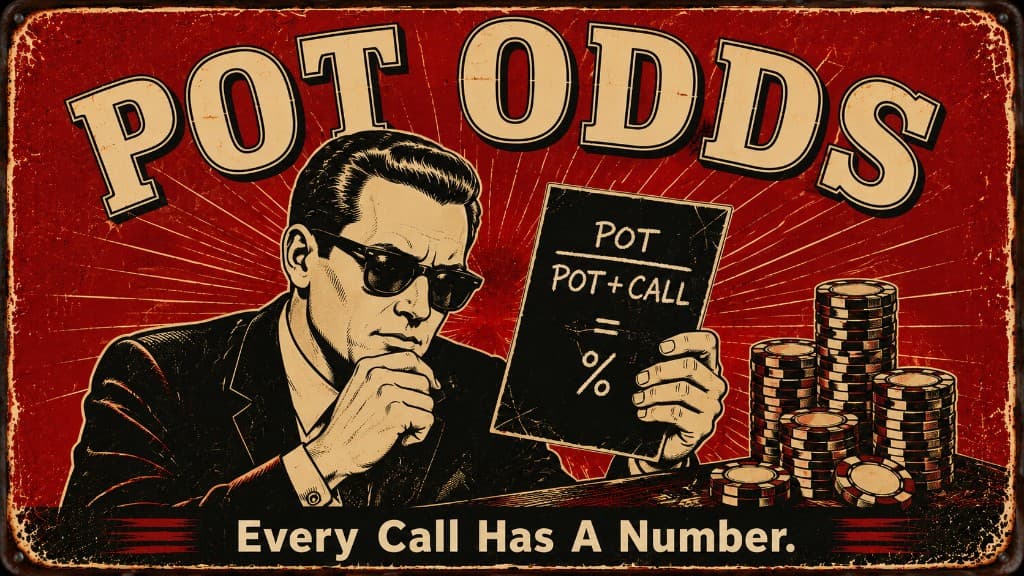
Vintage pulp poster: POT ODDS — Every Call Has A Number.
The idea

A call is never about the hand — it's about a price. Pot odds compare what you risk to what you can win, and give you the exact equity you need to break even.

The formula is quiet and ruthless: to call a bet, you need equity ≥ risk ÷ (risk + total pot after your call). Face a half-pot bet and you need 25% equity. Face a pot-sized bet and you need 33%.

Count your outs, convert to equity with the rule of 2 and 4, and compare. Do this enough and 'do I feel like calling?' is replaced by a number.

The vocabulary

Words that carry weight.

Pot odds

The ratio of the bet you must call to the total pot you'd win. Sets your minimum equity to continue.

Outs

The unseen cards that improve you to the likely best hand.

Rule of 2 and 4

×2 your outs on one street to come, ×4 with two streets, for a fast equity estimate.

Implied odds

The extra chips you expect to win on later streets when you hit — they justify some -EV immediate calls.

Case studies

Counting outs without fooling yourself

García Díaz walks through hypergeometric probabilities for cards left in the deck — the formal version of 'outs × 2 on one street'. When cards are drawn without replacement, shortcuts still work, but the math is combinatorial, not magical.

Nine flush outs on the turn ≈ 9/46 ≈ 19.6%. Compare that to the price: 50 to win 200 needs 25%. Raw pot odds say fold; implied odds say maybe call.

Source — García Díaz (2014). La Gaceta de la RSME 17(2), 247–271.

When a turn call sets up the river

Li's worked example: facing a turn bet with a flush draw, calling can be correct even below immediate pot odds because hitting the river lets you win a larger pot — provided villain will pay off when you make it.

Implied odds need a credible story: will they call a river bet after you hit? If not, the turn call is just burning chips.

Source — Li (2018). Exploitability and GTO Play in Poker. Boletín de Matemáticas.

Further reading
  • Matemáticas en el «Texas Hold'em Poker»: El arte de vencer a la suerte

    García Díaz (2014). La Gaceta de la RSME 17(2), 247–271.

    Combinatorics, hypergeometric outs, and expected value — the math layer behind every price you pay.

  • Exploitability and Game Theory Optimal Play in Poker

    Li (2018). Exploitability and GTO Play in Poker. Boletín de Matemáticas.

    Single-hand EV maximisation can lose long-run — ranges, implied odds, and balance matter across hands.

  • Most Important Fundamental Rule of Poker Strategy

    Ganzfried & Chiswick (2020). Most Important Fundamental Rule of Poker Strategy. AAAI.

    MDF alone is incomplete — integrate range advantage: defend at min(MDF, MDF − ½·RA + ¼).

  • The Search for GTO: Determining Optimal Poker Strategy Using Linear Programming

    Young (2017). The Search for GTO via Linear Programming. College of Wooster.

    LP formulations of simplified Hold'em make Nash equilibria concrete — the math behind solver output.

The drill
Your progress0%
?

Pot is 100. Opponent bets 50. You have a flush draw (9 outs) on the turn. Call or fold?

Show the answer →

Call. You risk 50 to win 150, needing 50 ÷ 200 = 25% equity. Nine outs on one card ≈ 9 × 2 = 18% — short on raw equity, but implied odds (the chips you win when the flush completes) push it profitable at most stack depths.

Calibration · Brier score5 prompts

Given the price, what equity do you need? Enter a percent. Score is (your forecast − true)² — perfect calibration is 0.

Prompt 1 / 5

Pot is 100. Opponent bets 50. What equity do you need to break even on a call?

Take this to the table

Before every call, name the price. Equity needed = risk ÷ (risk + pot). The number decides, not the gut.