← All units
Unit 01Foundations7 min

Think in Ranges, Not Hands

The single mental shift that separates recreational play from real study.

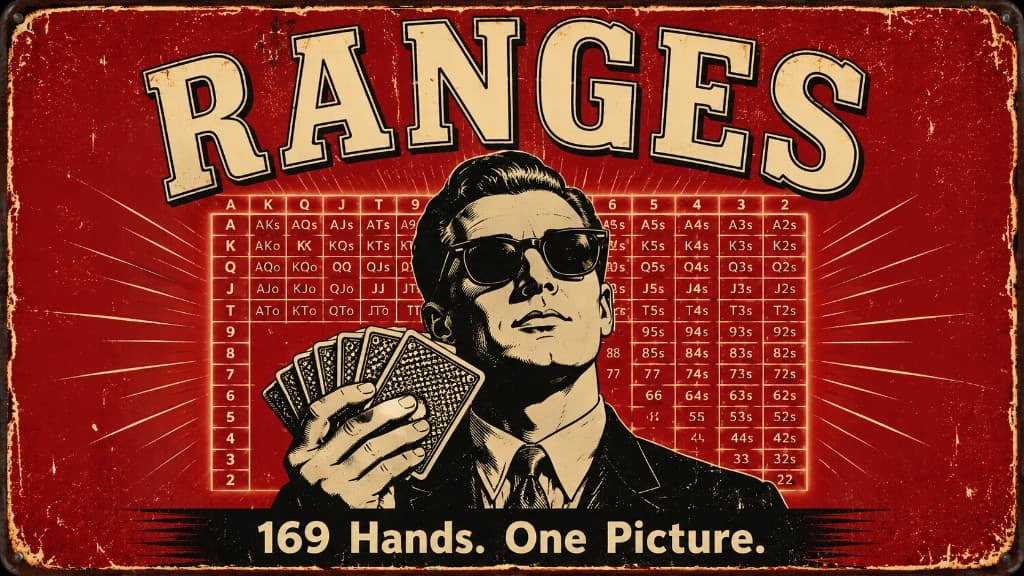
Vintage pulp poster: RANGES — 169 Hands. One Picture.
The idea

A beginner asks: what do I have? A studied player asks: what does my whole range look like here — and what does theirs?

You never hold just one hand in a spot. You hold every hand you'd play the same way. The grid on the home page is the map: 169 starting hands, coloured by what a solver does with each. Reading a board through ranges instead of your two cards is the whole game in one habit.

This is why poker shares an epistemic backbone with every other bet worth making — you act on the distribution of outcomes, never on a single certainty.

The map · hover a cellBTN open
RaiseMixedCallFold
BTN open · 50% of hands
The vocabulary

Words that carry weight.

Range

The full set of hands a player can have in a given spot, weighted by how often each occurs.

Combo

One specific two-card holding. AKs is 4 combos; AKo is 12; a pair is 6.

Polarised

A range split into strong value and bluffs, with the middle checked or folded.

Range advantage

Whose range contains more strong hands on a given board — it dictates who can bet aggressively.

Case studies

Skill beats luck — but only if the sample is long enough

Alon analyses simplified Hold'em models where stronger players win at rates that can't be explained by chance alone. The Central Limit Theorem then implies that over enough hands, results converge toward skill — not toward 50/50.

One bad session proves nothing. Track decisions, not outcomes, until the sample is large enough for skill to surface.

Source — Alon (2013). Poker, Chance and Skill.

Why solvers bucket the 169 grid

Fellows' abstraction work groups hands by strategic similarity on public boards — not by arbitrary colour. The range grid you train on is a compressed map of information structure, the same trick Billings et al. used to shrink full-scale Hold'em by 100 billion×.

When two hands share a colour on the matrix, the solver treats them similarly in that spot. That's a claim about strategy, not decoration.

Source — Fellows (2007). Pseudo-Optimal Hold'em Solutions. UCSD / AAAI Computer Poker Competition.

Further reading
  • Poker, Chance and Skill

    Alon (2013). Poker, Chance and Skill.

    Toy models of Hold'em show skilled players beat weaker ones at rates variance can't explain away forever.

  • Pseudo-Optimal Solutions to Texas Hold'em with Improved Chance Node Abstraction

    Fellows (2007). Pseudo-Optimal Hold'em Solutions. UCSD / AAAI Computer Poker Competition.

    Board-card bucketing from empirical strategy structure — ranges aren't arbitrary, they're abstracted information.

  • Approximating Game-Theoretic Optimal Strategies for Full-scale Poker

    Billings et al. (2003). Approximating GTO Strategies for Full-scale Poker. U. of Alberta.

    Abstracted 10¹⁸-node Hold'em down 100 billion× while keeping strategic structure — the blueprint for modern solvers.

The drill
Your progress0%
?

The board is A♠ K♦ 4♣. Who holds the range advantage: the preflop raiser or the caller?

Show the answer →

The preflop raiser. Their range is dense with AK, AQ, AA, KK — the caller flatted these away preflop, so ace-king-high boards smash the raiser's range. They can bet small and often.

Take this to the table

Stop asking 'is my hand good?' Ask 'how does my range interact with this board versus theirs?'