← All units
Unit 09Edge8 min

The River

Polarised pots, thin value, and blocker bluffs that actually work.

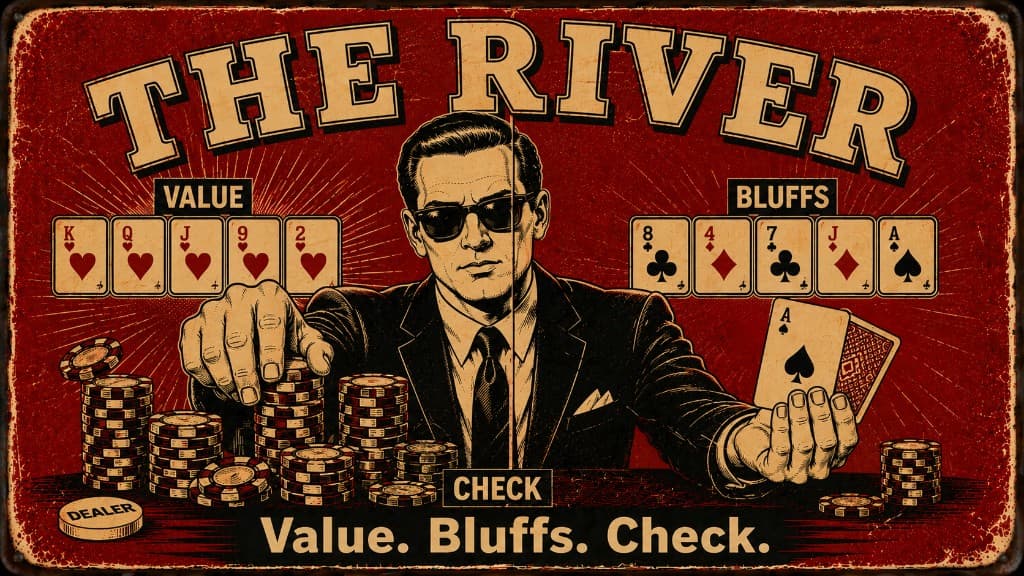
Vintage pulp poster: THE RIVER — Value. Bluffs. Check.
The idea

The river is the last card — no more outs, no more implied odds. Ranges polarise: value that wants a call, and bluffs that need a fold. Everything in the middle wants to check and show down.

Thin value is the skill that separates winners: betting hands that beat enough of their continue range to print, even when they look ‘medium’. Blocker bluffs (holding cards that make their strong hands less likely) turn air into profitable pressure — but only when the story you told on earlier streets still holds.

Sizing follows polarity. Big bets for nut advantage and pure bluffs; smaller bets for thin value against capped continues. If you can’t name who you’re targeting, check.

The vocabulary

Words that carry weight.

Polarised river

A betting range of strong value + bluffs, with medium hands checking.

Thin value

Betting a hand that wins often enough vs calls, even if it isn’t the nuts.

Blocker bluff

Bluffing with cards that remove opponent nut combos (e.g. the ace of their flush suit).

Missed equity

Hands that had outs on the turn and now have none — common bluff candidates if the line supports it.

Case studies

MDF + range advantage on the last street

Facing a pot-sized river bet, MDF says defend 50% of your range. Ganzfried's rule adjusts down when range advantage is against you — and up when you hold the nut advantage. Polarised rivers are where that adjustment shows up as hero calls or disciplined folds.

Pot-sized river bet, you're capped, board favours their preflop range → fold more than MDF. Don't hero-call because 'pot odds'.

Source — Ganzfried & Chiswick (2020). Most Important Fundamental Rule of Poker Strategy. AAAI.

Thin value when they cap themselves

Li's river scenario: after a checked-down line, a medium-strength hand can bet for thin value because villain's range is weak and calling wide with second pair. The river isn't only bluff-or-nuts — it's targeting who still calls.

They checked twice and you beat their obvious calls? Small value bet. If they only call with hands that beat you, check.

Source — Li (2018). Exploitability and GTO Play in Poker. Boletín de Matemáticas.

Further reading
  • Most Important Fundamental Rule of Poker Strategy

    Ganzfried & Chiswick (2020). Most Important Fundamental Rule of Poker Strategy. AAAI.

    MDF alone is incomplete — integrate range advantage: defend at min(MDF, MDF − ½·RA + ¼).

  • Exploitability and Game Theory Optimal Play in Poker

    Li (2018). Exploitability and GTO Play in Poker. Boletín de Matemáticas.

    Single-hand EV maximisation can lose long-run — ranges, implied odds, and balance matter across hands.

The drill
Your progress0%
?

Board is A♠ K♦ 7♣ 2♥ 8♠. You have A♣ 5♣ for top pair weak kicker. Opponent checks to you. Value bet, or check back?

Show the answer →

Often a small value bet. Their check-capped range includes many worse aces, king-high, and missed draws that call a small size. You’re not bluffing — you’re charging the hands that beat nothing but call too wide. Check back only if this opponent never calls thin.

Take this to the table

On the river: value that gets called by worse, bluffs that fold out better, everything else checks. Name the target before you click bet.