← All units
Unit 06Edge6 min

Bankroll & Variance

The skill that keeps you in the game long enough for skill to matter.

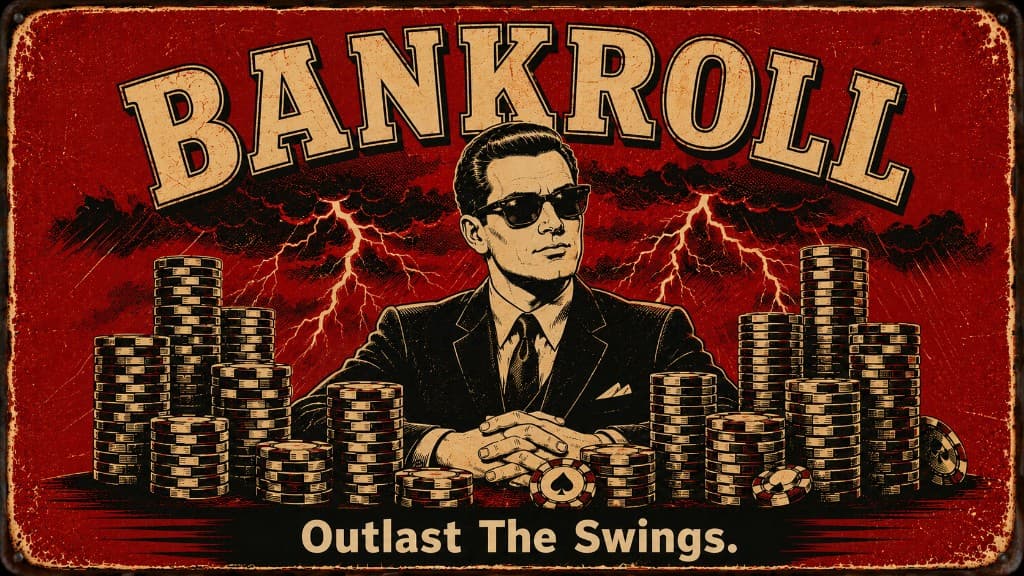
Vintage pulp poster: BANKROLL — Outlast The Swings.
The idea

Poker is a positive-EV bet wrapped in brutal short-term variance. You can play perfectly and lose for weeks. Bankroll management is the discipline that lets the long run arrive before you go broke.

The rule is boring and it works: keep enough buy-ins that a normal downswing can't bust you (20–40+ for cash, more for tournaments), and move down when the roll shrinks. Detach the money you play with from the money you live on.

This is the exact structure of every serious bet Dragonfly makes — a domain portfolio, a product launch, a design gamble. Size the position so no single bad beat ends the game.

The vocabulary

Words that carry weight.

Variance

The natural swing of results around your true winrate. High even for winning players.

Bankroll

The dedicated pool of money for playing — walled off from living expenses.

Downswing

An extended stretch below expectation. Survivable only if properly rolled.

Risk of ruin

The probability of losing your whole bankroll given your edge, variance, and buy-in count.

Case studies

Variance is the tax on skill

Alon shows skill dominates in simplified models, but single sessions remain noisy. Ganzfried & Chiswick note that even amateurs can win a WSOP Main Event hand against pros — which is why bankroll depth matters more than ego.

If your roll can't survive 20 buy-ins of normal variance, you're not playing poker — you're gambling on not running bad.

Source — Alon (2013). Poker, Chance and Skill.

Expected value as a discipline

García Díaz frames every decision as E[X] = Σ xᵢ·pᵢ — the same structure as pot odds, just written for mathematicians. Positive EV repeated enough times is how 'the long run' becomes literal.

Log the decision quality, not the result. A correct fold that would have won is still correct.

Source — García Díaz (2014). La Gaceta de la RSME 17(2), 247–271.

Further reading
  • Poker, Chance and Skill

    Alon (2013). Poker, Chance and Skill.

    Toy models of Hold'em show skilled players beat weaker ones at rates variance can't explain away forever.

  • Matemáticas en el «Texas Hold'em Poker»: El arte de vencer a la suerte

    García Díaz (2014). La Gaceta de la RSME 17(2), 247–271.

    Combinatorics, hypergeometric outs, and expected value — the math layer behind every price you pay.

The drill
Your progress0%
?

You have €600 and want to play. Which stake — €1/€2 (€200 buy-in) or €0.25/€0.50 (€50 buy-in)?

Show the answer →

€0.25/€0.50. Three buy-ins at €1/€2 is a bust waiting for a downswing. Twelve buy-ins at €0.25/€0.50 lets your edge outrun variance. Move up only when the roll — not the ego — says so.

Take this to the table

Manage risk of ruin like a portfolio: size every bet so no single swing can knock you out of the long run.